
The Case of 5-Amino-1MQ: Navigating CAS Registry Nomenclature —
Can Two Different Substances Share the Same CAS Number?
Author: Technical support / Category: Technical Bulletins /
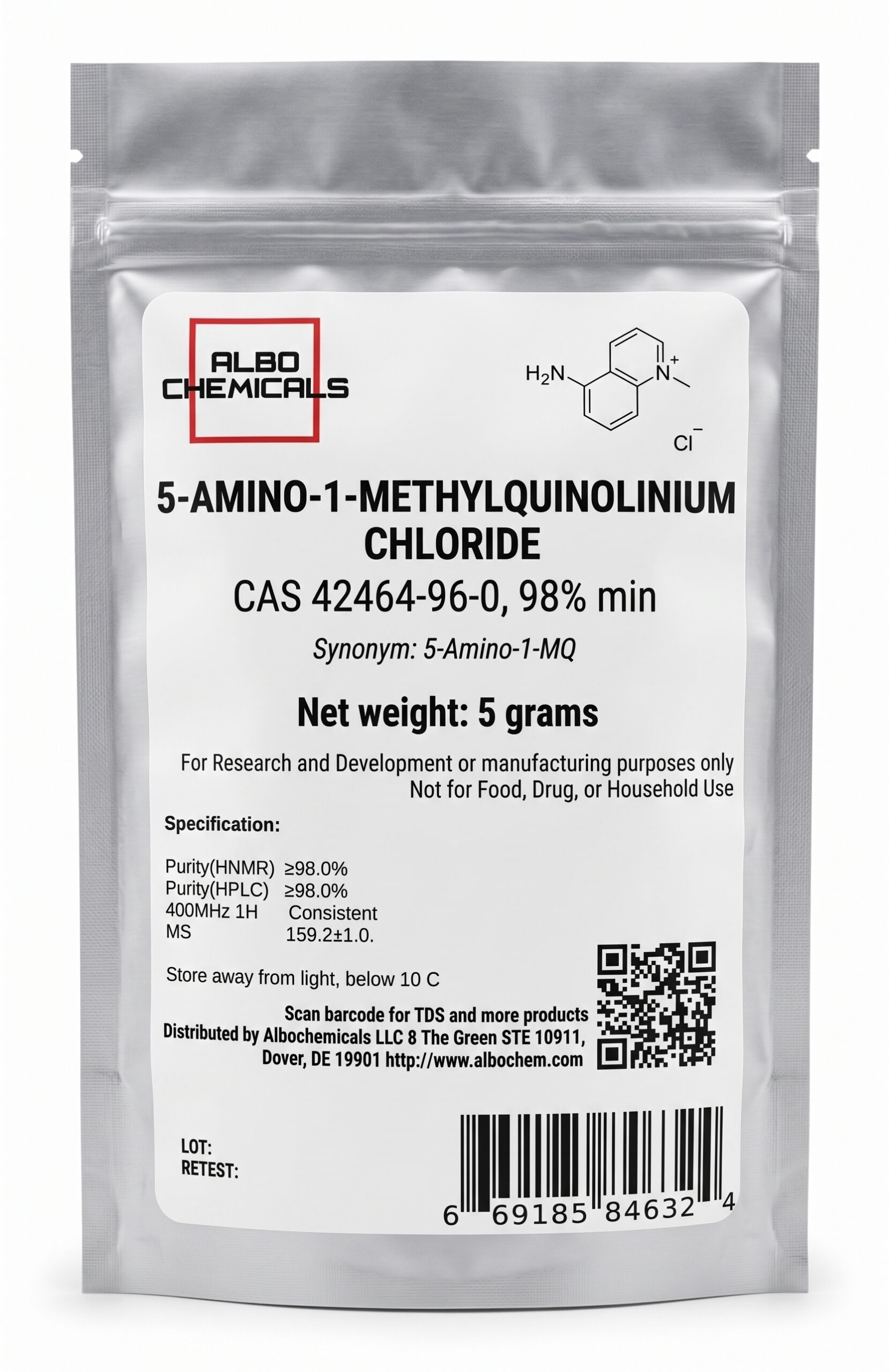
Executive Summary: Yes. In industry practice, varying salt forms, hydration states, and structural analogs frequently share a parent CAS identifier.
Introduction:
In chemical procurement and laboratory formulation, the Chemical Abstracts Service (CAS) Registry Number serves as the universal standard for identifying chemical substances. However, researchers and procurement specialists frequently encounter cataloging anomalies, particularly regarding varying salt forms of a parent compound. A prominent example of this in current chemical literature and supplier databases involves 5-Amino-1-methylquinolinium and its associated salts.
The 5-Amino-1MQ Nomenclature Overlap
Currently, the CAS number 42464-96-0 is widely utilized across the chemical supply industry to designate 5-Amino-1-methylquinolinium chloride. However, from a strict nomenclatural standpoint, this CAS number originally designates the iodide salt form of the compound (5-Amino-1-methylquinolinium iodide).
Why has this overlapping designation become an industry standard?
-
Focus on the Active Moiety: In research applications, the compound of interest is the primary cation—the 5-amino-1-methylquinolinium molecule itself. The anion (chloride vs. iodide) simply serves to stabilize the salt.
-
Database Consolidation: Major chemical reference databases, including ChemicalBook and various global supplier indices, often group structural analogs and salt variations under the most frequently queried parent CAS number to streamline searchability. Over time, as the chloride salt became the preferred form for research due to distinct solubility profiles, the original iodide CAS number (42464-96-0) was colloquially retained by manufacturers and catalogers to identify the compound family.
For researchers purchasing 5-Amino-1-methylquinolinium chloride (≥99%), it is standard practice to see CAS 42464-96-0 listed on the Material Safety Data Sheet (MSDS) and Certificate of Analysis (COA), provided the molecular weight and structural formula on the documentation match the chloride salt specification.
Broader Industry Precedents
This phenomenon of shared or consolidated CAS numbering is not unique to 5-Amino-1MQ. Chemical industry frequently sees this with other complex molecules where the base structure is the primary focus:
-
Tianeptine: The base CAS number 66981-73-5 (Tianeptine sodium) is often loosely applied across databases to reference other distinct salt forms, such as Tianeptine sulfate or the free acid form, despite those molecules having distinct molecular weights and varying degrees of cataloged registration.
-
BPC-157: The baseline sequence CAS 137525-51-0 refers to the parent peptide structure. However, in procurement, this same CAS is frequently utilized to categorize both the acetate and arginate salt forms, requiring researchers to verify the specific salt via secondary documentation (such as HPLC/MS reports) rather than relying on the CAS string alone.
- Berberine: Berberine is a frequently utilized botanical alkaloid in research and formulation. Berberine Hydrochloride (HCl) has the CAS number 633-65-8. Because this is the most common form, many overseas manufacturers will list Berberine Sulfate under the exact same CAS number.
Even broader examples of shared CAS numbers include: Polymers of Different Lengths ( CAS Grouping), Substances with different Hydration States (Regulatory Grouping) or UVCBs (Unknown or Variable Composition Materials)
- Polyethylene Glycol (PEG): PEG 200 is a clear, viscous liquid. PEG 8000 is a hard, white, waxy solid. Despite having vastly different molecular weights and physical properties, they share the exact same CAS number (25322-68-3) because they are made of the same repeating monomer unit.
-
Calcium Chloride: The anhydrous version is CAS 10043-52-4, and the dihydrate version (two water molecules attached) is CAS 10035-04-8. In practice, many Safety Data Sheets (SDS) and bulk chemical suppliers use the anhydrous CAS number for all hydration states to simplify their inventory and regulatory reporting.
- Phthalo Green (Pigment Green 7): This common green pigment has the CAS number 1328-53-6. However, its molecular structure can contain anywhere from 14 to 16 chlorine atoms. You can buy this pigment from two different suppliers under the exact same CAS number, and the chemical composition will actually be slightly different.
Best Practices for Laboratory Procurement When sourcing raw materials and chemical reagents, the CAS number should be treated as a primary search index rather than the sole arbiter of molecular identity. Researchers must always cross-reference the CAS number with the provided TDS, paying specific attention to the documented molecular weight, elemental analysis, and structural formula to confirm the exact salt form being acquired.
Researchers can also perform a simple qualitative limit test to verify the complete absence of the iodide counterion.
Product offered on our site is a Chloride salt of the compound:
-
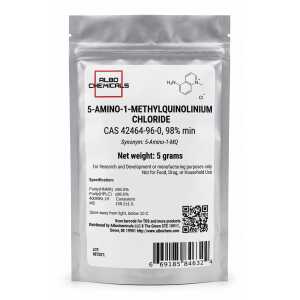
5-Amino-1-methylquinolinium Chloride – 5-Amino-1MQ (CAS 42464-96-0), ≥99%, 5 grams
$32.75 Add to cart -
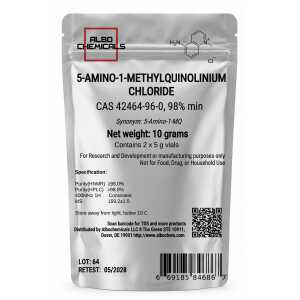
5-Amino-1-methylquinolinium Chloride – 5-Amino-1MQ (CAS 42464-96-0), ≥99%, 10 grams
$55.25 Add to cart -
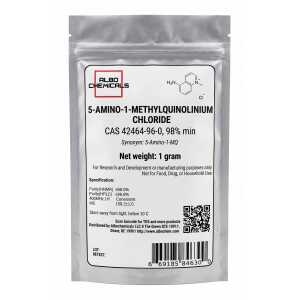
5-Amino-1-methylquinolinium Chloride – 5-Amino-1MQ (CAS 42464-96-0), ≥99%, 1 gram
$18.25 Add to cart
5-Amino-1-methylquinolinium Chloride (CAS 42464-96-0), ≥99%
Synonyms: 5-amino-1-methylquinolin-1-ium chloride; 5-Amino-1MQ
5-Amino-1-methylquinolinium chloride is a synthetic small-molecule quinolinium derivative provided as a dry solid powder. This material is synthesized strictly for use as an analytical reference standard, in vitro reagent, and raw material for non-clinical laboratory research.
Specification:
- Synonyms: 5-amino-1-methylquinolin-1-ium chloride; 5-Amino-1MQ
- CAS Registry Number: 42464-96-0
- Molecular Formula: C10H11ClN2
- Appearance: Solid powder
- Purity(HNMR) ≥98.0%
- Purity(HPLC) ≥98.0%
- 400MHz 1H Consistent
- MS 159.2±1.0.
- Storage Conditions: Store in a cool, dry environment away from direct light. Recommended storage at -20°C for optimal long-term stability.