
Introduction
In the quantitative analysis of non-steroidal compounds containing sensitive heterocyclic rings, maintaining sample stability during preparation and execution phases is critical for achieving reproducible chromatographic data. RU58841 (4-[3-(4-hydroxybutyl)-4,4-dimethyl-2,5-dioxoimidazolidin-1-yl]-2-(trifluoromethyl)benzonitrile; CAS 154992-24-2) is an industrial research chemical that exhibits high susceptibility to hydrolytic cleavage when exposed to aqueous environments.
When conducting purity verifications via Reversed-Phase High-Performance Liquid Chromatography (RP-HPLC), unoptimized sample preparation or improper column selection can induce rapid, artifactual degradation. This results in false-low purity readings and misidentified degradation peaks. This technical bulletin outlines the kinetic mechanisms of RU58841 hydrolysis and details the specific solvent parameters and stationary phase selections required to ensure analytical accuracy.
The Kinetics of Hydrolytic Degradation in RU58841
The molecular architecture of RU58841 features a heavily substituted imidazolidine-2,4-dione (hydantoin) core structure flanked by a trifluoromethyl-substituted benzonitrile group and a hydroxybutyl side chain. The carbonyl carbons within the central dihydouracil/imidazolidine ring system are highly electrophilic.
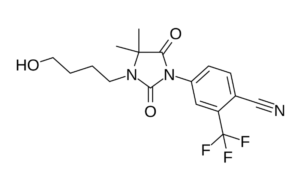
RU58841 structural formula
In the presence of water H2O, even in trace amounts, a nucleophilic attack occurs at these carbonyl centers. This process breaks the heterocyclic ring structure, initiating a cascade that degrades the parent compound into distinct hydrolysis artifacts, primarily carboxylic acid derivatives and amine fragments:
Because this reaction occurs rapidly at room temperature, any presence of water in the sample dissolution solvent (diluent) will cause the compound to degrade inside the auto-sampler vial before the injection sequence even begins.
Chromatographic Confounders: On-Column Hydrolysis
A secondary failure point occurs during the mobile phase interaction inside the HPLC column. Standard RP-HPLC protocols routinely utilize binary gradients consisting of an aqueous phase (e.g., Water with 0.1% Formic Acid) and an organic phase (e.g., Acetonitrile).
If a technician runs a protracted, low-flow gradient method on a standard, long analytical column (e.g., 5 μm 4.6 x 250 mm C18 column), the sample remains in a highly aqueous, elevated-temperature column oven environment for an extended duration. This prolonged residence time triggers on-column hydrolysis. As the sample travels through the stationary phase, it continuously decomposes, presenting on the chromatogram as an unresolvable tailing peak, a baseline shift, or a multi-shouldered peak artifact that incorrectly indicates a low-purity raw material.
Optimized Analytical Protocol Specifications
To neutralize moisture-induced degradation and capture the true purity profile of raw RU58841 bulk material, laboratories must enforce strict anhydrous preparation and rapid-elution parameters.
[Sample Prep] [HPLC Column Injection]
100% Anhydrous ACN Matrix ======> Short Core-Shell C18 (Sub-3 µm Column)
(Prevents Pre-injection Hydrolysis) (Minimizes Retention & On-Column Transit Time)
1. Matrix Diluent Selection
-
Prohibited: Water, aqueous buffers, or technical-grade solvents with high water content.
-
Mandatory: 100% HPLC-grade, anhydrous Acetonitrile ACN or anhydrous Methanol MeOH
-
Protocol: Raw powder samples must be dissolved immediately prior to injection. The volumetric flasks and auto-sampler vials must be pre-purged with dry nitrogen gas if ambient humidity exceeds 40%.
2. Column Architecture and Stationary Phase
To minimize the compound’s transit time through the aqueous mobile phase gradient, long columns with large particle sizes must be avoided.
-
Optimized Configuration: Use a high-efficiency, short-length column, such as a Core-Shell C18 (2.1 x 50 mm or 4.6 x 100 mm) with a sub-3 micron particle size (1.7 μm to 2.7 μm).
-
Mechanism: The core-shell morphology drastically decreases mass transfer resistance, allowing for accelerated flow rates (1.2 mL/min to 1.5 mL/min) and highly compressed gradient run times. This reduces the total water-contact window of the molecule to under 4 minutes, completely eliminating artifactual on-column hydrolysis.
3. Mobile Phase Optimization
-
Organic Phase (A): Acetonitrile with 0.05% Trifluoroacetic Acid (TFA).
-
Aqueous Phase (B): Ultra-pure Deionized Water with 0.05% TFA.
-
Gradient Profile: Implement a steep, rapid linear gradient shifting rapidly from 30% A to 90% A within 3 to 5 minutes to sweep the intact hydrophobic parent molecule off the column before degradation kinetics can initiate.
Laboratory Storage Considerations
Given its thermodynamic instability in the presence of moisture, bulk storage of RU58841 raw powder mandates absolute isolation from atmospheric air. It must be stored in double-sealed containers with active desiccant packs at temperatures below -20 ºC. Prior to opening containers for analytical weighing, the vessel must be allowed to equilibrate fully to room temperature to prevent the immediate condensation of atmospheric moisture onto the hygroscopic chemical powder.
-

RU58841 Powder | CAS 154992-24-2 | ≥98% Purity | Manufacturing Intermediate, 10 grams
$42.25 Add to cart -
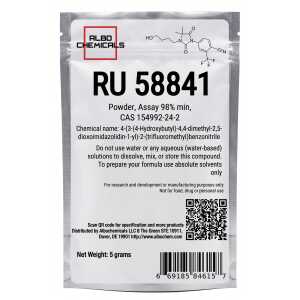
RU58841 Powder | CAS 154992-24-2 | ≥98% Purity | Manufacturing Intermediate, 5 grams
$25.50 Add to cart -

RU58841 Powder | CAS 154992-24-2 | ≥98% Purity | Manufacturing Intermediate, 100 grams
$360.00 Add to cart